In November 2007, Lindsay Ridgeway developed a series of performance tests as a method of training Lumi and Laddie, his two Golden Retrievers, for field sports. This is the journal of their progress through that series and beyond. Contact: LDRidgeway at gmail dot com.
Thursday, July 9, 2015
Five blinds at golf course (with photos)
Sunday, July 5, 2015
Six golf course blinds (with photos)
I carried a single orange bumper. Laddie carried a white puppy bumper most of the time as he explored while I wandered around setting up blinds, but eventually he lost it. Maybe we'll find it another day.
We ran six blinds, distances 150-200y. Factors included treeline wraps, logs, keyholes, ditches to cross rather than going over nearby bridges, and an angle water entry with shoreline swim. Laddie did a good job, taking every obstacle and never requiring me to pick up for a slow sit.
Here are twelve pictures, two of each blind. One picture in each pair uses normal focus to give perspective on the distance, the other uses zoom focus to show details of the factors.
#1. Blind past woods
Friday, July 3, 2015
Three triples next to a pond, and a treeline blind, at a golf course
Since Laddie was knocked out of his last two trials after arriving at the last series, the water triple, at or near first place, we've been focusing on water triples (or, in some cases, doubles) for the last several sessions. However, I haven't been using three assistants because of the expense or, in some cases, lack of availability.
I've used a number of strategies for running a triple with only one or two assistants, as described in the last few posts. Today, I used one of those strategies, and I also introduced a different strategy for two of the triples: I had my assistant throw a momma-poppa, and then I left Laddie in a sit while I went to the go-bird gun station to throw the last mark, and then returned to run Laddie on all the marks.
Here's a description of the three triples, followed by a treeline blind, we ran today:
Series A. Water triple
I started by putting out two chairs with white jackets. My assistant threw a momma-poppa from the first chair, then I threw a side-throw so that he could move to the other chair, and there he threw the go-bird. The line to the go-bird included an angle entry across a thin slice of the pond. Laddie started to run the bank, so I called him back and re-sent him. He then ran a good line. The same thing then happened on the poppa, which was thrown in the middle on a line that was under the arc of the go-bird (something I've never seen in an event, but that's what I set up). That mark was longer than the go-bird but also featured an angle entry across a thin slice of the pond, and again, Laddie got it wrong the first time and right the second time. Finally, Laddie nailed the long memory bird on the left, which included diagonally crossing a water-filled ditch.
Series B. Land/water triple
I left the first chair from Series A where it was, but moved the second chair to the opposite side of our start line, which I also moved some distance to change the angles. I positioned my assistant at the new chair placement and showed Laddie both gun stations, then called for the first bird, the momma of a momma-poppa thrown by my assistant. This mark had no water segment and was in open field, away from any features. Next I called for the poppa. Then I left Laddie at the start line and walked to the chair we'd used for the Series A momma-poppa, and threw a mark similar to that poppa as the go-bird. Finally I returned to the start line and ran Laddie on all three marks.
This time, Laddie ran the go-bird correctly the first time, but he again needed two tries on the middle bird, starting to run the bank the first time I sent him. Finally he nailed the momma, which turned out to be too easy for any useful training as far as I could see.
Series C. Land/water triple
I again positioned two chairs with white jackets and positioned my assistant at one of them. He again threw the momma of a momma-poppa as a land mark for the first throw, though this time on an angle in, which I hoped might provide some training benefit as a check-down. The poppa was thrown to the edge of the pond into a clump of reeds. Next I left Laddie at the start line and went to the other chair, threw the go-bird, and returned to run Laddie on all three marks.
Although the go-bird was another difficult angle-entry with an easy cheat, Laddie ran it correctly the first time. The line to the middle bird was another difficult angle-entry with an easy cheat, then a shoreline swim to a point that the line was outside of, then another shoreline swim to the mark. Laddie took the water entry correctly the first time, and might have completed the entire mark correctly without handling. But I thought he was veering too close to the shore after he passed the point, and I didn't want to reach the shore so I blew my whistle and cast him back away from the shoreline. He took the cast and completed the mark on a good line. He then nailed the memory-bird, the check-down providing no noticeable challenge. He just ran straight to it.
Series D. Treeline blind
Once again I set up a land blind to end the day's work, and once again I had the line run past a treeline (today's was on the left) that ended with an opening that would tend to act as suction for the dog to wrap around the trees and into that opening. Today's blind was 300y+, hilly, and started with a short land segment to a diagonal crossing of a ditch, with a large branch on the far shore that Laddie would have to run around and off line, then get back on line. The rest of the blind was wide open on the left as the dog approached the woods, then past the woods to the blind. Laddie needed about ten whistles to make a zig-zag run of the entire blind within a reasonably narrow corridor, but had good whistle sits, reasonable casts, and no auto-casts. He didn't attempt to wrap around the woods at the end, and remained in control the whole time to the blind.
Thursday, July 2, 2015
Water double, two water triples, and a land blind
Sunday, June 28, 2015
Land and water blinds on golf course
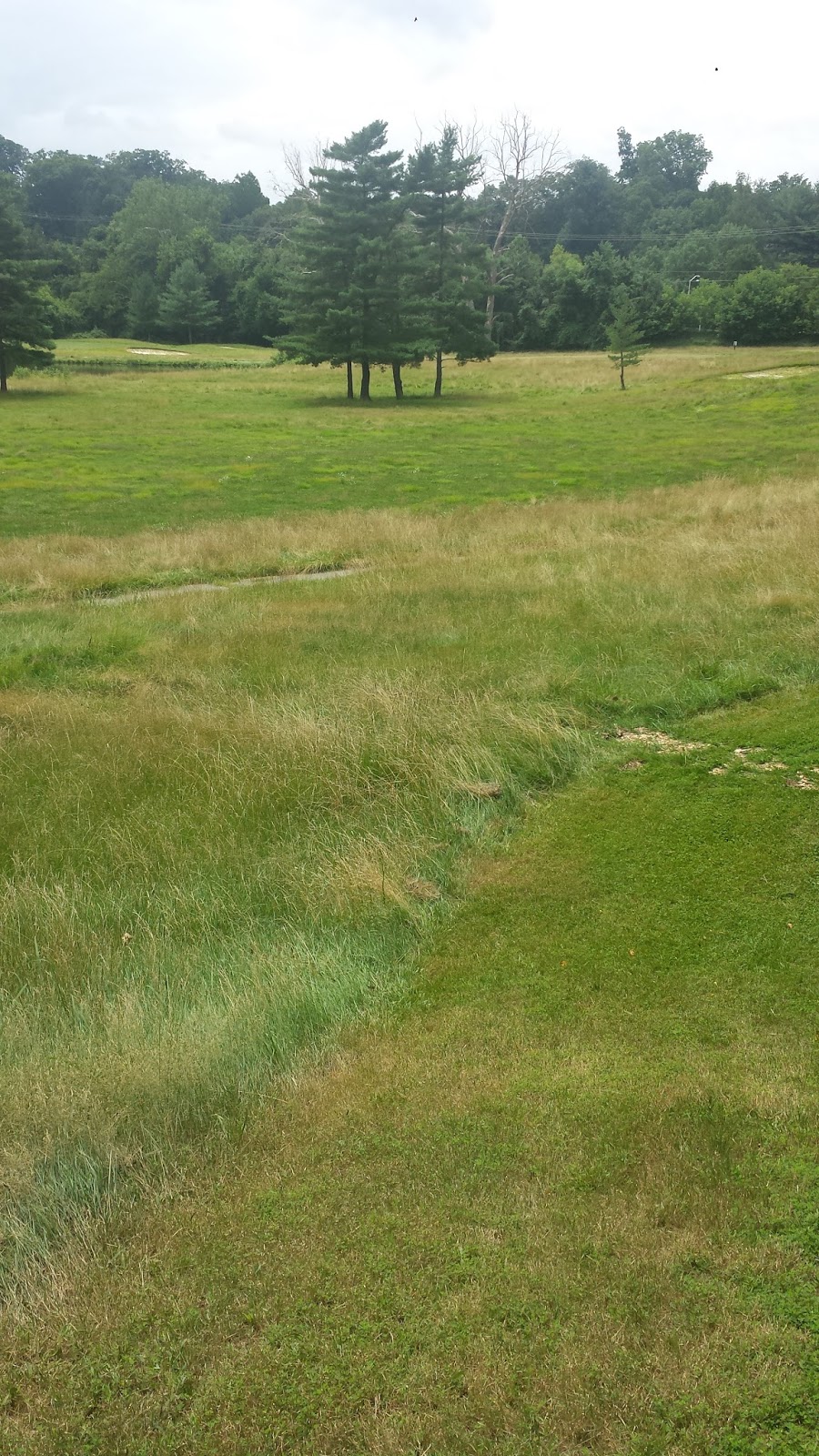
So even though we couldn't run marks without assistants, I took him to the nearby, recently closed golf course, and we went for a long walk to run blinds. I wore white jacket and black gloves (I'd like to recommend Gorilla Grips gloves from Home Depot for anyone interested), and carried along a lining pole and three 2" orange bumpers, though it turned out I never used the lining pole and only needed one bumper.
As we walked, I'd locate a blind I'd like to run Laddie on, place the orange bumper, and then continue walking till we reached the start line I wanted to use.
Laddie also kept active running after his 2" white (puppy) bumper, which I'd throw as we walked and also as Laddie was en route back with the blind retrieves. Those throws were in effect bulldogs, but as far as I know bulldogs aren't used in field trials and I don't plan to run Laddie in any more hunt tests, where bulldogs do occur. We do them just for fun and perhaps to somewhat tune Laddie's marking focus and memory.
Laddie ran a total of about a dozen blinds, varying in distance 150-300y+, and with a wide variety of orientations (wind direction and sun placement) and other factors (including mounds, keyholes, branches to climb over, treelines to run past and avoid wrapping around at the end, channels, and shoreline swims).
Here are photos of a couple of the blinds:
210y water blind across channel with fast RTL flood-waters, past clump of reeds with wrap suction to left, then pond re-entry with suction to left, swim across corner of pond with suction to left, angle exit with squaring suction to left, thru land keyhole under tree branches with open-space suction to left both before and after tree, short land segment to reeds at back of last point (zoomed focus)
180y land blind along a treeline, with wrap suction to the left at mid-point and at the end
The only other time I needed to re-run him was on a relatively short blind (no photo) across the corner of a pond, with a large branch on the far shore for Laddie to climb over before completing the land segment to the blind. Laddie repeatedly squared the water entry, no matter how carefully I lined him up, and each time, I called him back. Finally, I left him in a sit and walked to the blind. There I picked up the bumper, showed it to him, and dropped it back to the ground. When I returned to run him for the last time, he again took a squared entry into the water, but not too bad, and handled easily to the blind, scrambling over the branch without difficulty.
Saturday, June 27, 2015
Three water multiples with re-entries, and a land blind
For Thursday's session, I picked up one assistant and we trained again at our nearest training property. The work went as follows:
Series A. Water double
This was a momma-poppa double. The momma was thrown to the left, from a point over a channel, a bridge configuration. The poppa go-bird was thrown to the right. The line to the go-bird included a difficult angle entry as a water re-entry.
Laddie ran both marks well and without difficulty.
Series B. Water triple
Using a complicated sequence of steps by my assistant, this triple consisted of a retired momma-poppa and a re-entry mark as the go-bird.
First I placed chairs with white jackets at each gunner station. Then Laddie and I came to our start line while my assistant waited at the momma-poppa station beyond the left corner of the pond we were using. He threw the momma LTR on an angle back, then the poppa RTL on an angle in across the corner of the pond.
Next I three a side throw into the water to distract Laddie. As he retrieves it, my assistant left the white jacket on the momma-poppa chair and ran to the other chair. When Laddie returned with the side throw, my assistant threw the go-bird mark LTR on an angle back. The line to that mark included a difficult re-entry. Laddie nailed that mark.
As Laddie was coming back from the go-bird, my assistant ran back to the momma-poppa chair, grabbed the white jacket, and ran back. So when Laddie returned to the start line, the momma-poppa gun station was retired.
I then sent Laddie to pick up the mark on the left, and the the mark at the end of the pond and across a land segment to the tree line.
Laddie did fine on all three of these marks.
Series C. Water triple
Whereas Series B was a momma-poppa water double followed by a re-entry water mark, Series C was a re-entry water mark followed by a momma-poppa water double.
This one was run as follows:
First, my assistant threw from the right gun station, LTR on an angle back. Then I threw a side-throw fit Laddie to give my assistant time to run to the other gun station on the left. Then my assistant threw the momma RTL on an angle back, and the poppa RTL on an angle in as the go-bird.
Both the first and last throws of the triples were difficult re-entries, and in each case, Laddie began to run the bank after he crossed the first water segment. In each case, I called him all the way back to the start line and sent him again, and then he ran the mark correctly.
After Laddie ran both re-entries, I sent him to pick up the momma throw, which was on a line that crossed a channel on a diagonal, then took a land segment immediately in front of and to the left of the gunner, then continued to the side of a large shrub. It had been a long time since Laddie had seen that throw, and it's unusual for me to set up a momma-poppa with both throws to the same side, so Laddie took a line behind the gunner and then ran thirty yards past the shrub on the wrong side. But he then checked straight back to the mark.
Series D. Land blind
For the land blind, I set up a scenario similar to many qual land blinds I've seen: a 200y+ blind along the edge of a section of woods, with the blind planted twenty yards beyond the end of the wooded section, visually inviting the dog to wrap around behind the woods and out of sight, thus a DQ.
Laddie had one slow whistle sit and I walked out to pick him up. After that, his whistle sits were good, and he took good care most of the way, though he kept scalloping toward the woods, as most dogs running such a blind tend to do in my experience. Unfortunately, Laddie did take the wrap and slipped the whistle when I tried to stop him. He can back into sight when I blew a come-in whistle and took a cast to the blind, and that might have been good enough to pass a qual, depending on the judges, but if I'd had more time, I should have walked all the way out and bright him back when he slipped that whistle on the wrap. But that would have taken at least another twenty minutes, maybe longer, and I couldn't afford the time.
Overall I felt this session provided Laddie with a good rate of reinforcement while still practicing a useful set of challenges.
Thursday, June 25, 2015
Three water triples featuring re-entries, and a land blind
All of the water marks included one or more challenges such as angle entries, swims beside a shoreline, and big swims, and all included at least one re-entry. Laddie only needed help on one of the nine marks, an improvement from yesterday, but I can't be sure whether that was because he was learning to remember the marks better or they were easier to remember. On two of the re-entries, he started to cheat and I called him back to the start line, then resent him and he ran the mark correctly.
The land blind was longer than some we've used for practice lately, but I incorporated no diversions. It included a fairly narrow keyhole at ~200y. Laddie got thru the keyhole in two whistles, and had high quality sits and casts from beginning to end. Here's a video:
Note on the video: I see that on one of the casts, I dropped my right arm while casting with my left arm. It looks like I'm inadvertently giving him two different casts simultaneously. I don't know how often I do that, but I'm guessing pretty often, since I had no idea I was doing it. I don't know how Laddie is supposed to know what that means!
Monday, June 22, 2015
Three single bird-girl water triples and a land blind
Based on Laddie's last two trials, I feel this might be a good time to work on water triples, especially with temps in the high 80s and 90s. But that meant a long drive and, to limit the expense, I decided to bring along just one assistant to act as bird-girl, that is, thrower or gun or gunner.
That meant that the three marks of each triple would all be thrown by a single gunner. That's not something that would happen in competition as far as I know, but it seemed to make the setups that much more challenging and hopefully added to their value as preparation for events we'll be running in the fall.
Because of the heat, and also under some time constraint, I wanted to use relatively short marks, but in configurations that would be difficult enough to strengthen Laddie's skills. Here's what I came up with:
Series A. Single bird-girl water triple
The first throw was on the left, RTL down an embankment into a clump of cover on a slope in front of a tree. The line to the fall from the start line was a short land segment to a difficult angle entry across a corner of a pond, then across a strip of land and diagonally across a channel to the embankment.
After the gunner threw the first mark, she moved to line's right and made the second throw, again RTL down an embankment into a clump of cover on a slope in front of a different tree. My intent was that the two marks would look nearly identical, just a few degrees angle from one another. The line to the second mark was easier: a land segment, then a channel crossing to the embankment.
For the third mark, the bird-girl did not move, making the second two throws what's called a momma-poppa, often a confusing and difficult configuration for a retriever. The last throw was fairly easy, though, an angle back LTR into a depression in shadows on the land segment at the far side of the channel crossing. After the last throw, the bird-girl sat down on a chair, remaining visible as Laddie ran the marks.
Laddie had little difficulty with the go-bird but did not seem to remember either of the other two lines. I did not ask the gunner for rethrows or other help, but instead took the opportunity to blow the whistle and switch Laddie from marking mode to handling mode, something we rarely practice and something he seemed to have some difficulty with in a couple of trials this sitting.
I had not been certain whether Laddie would find a relatively short, single bird-girl water triple difficult, but not I knew that he would and felt we should continue to work on various versions of that format.
Series B. Single bird-girl water triple
Since Series A had featured a momma-poppa as the last two marks, for Series B, I made them the first two marks, in effect retiring the momma-poppa gunner. This was the setup:
The first throw was an angle back LTR in front of a tree. The line to it would be a center channel swim, a channel crossing, and a short land segment.
The second throw was from the same position of the gunner, this time an angle in LTR in front of a closer tree. The line to it would be a short channel swim close to the shore line, then a channel swim, and up onto shore to the base of the tree.
After the bird-girl threw those two marks, she ran on an angle back to line's left 70y, and then threw a flat throw LTR before sitting in a chair while Laddie ran the marks. The line to the third mark was to the left of the others, though all three were tight, within a thirty-degree angle. This time the line across the channel was tight to shore on Laddie's other side, and the land segment to this third mark, the go-bird, had the unusual feature of being easily the longest of the three marks and the more unusual feature of requiring Laddie to run past both of the other marks while they were still down to get to the go-bird.
Laddie had no trouble with the go-bird, including no attempt to bail out and come up on the side shore on this or the other channel crossings. He didn't seem to remember the exact line to the mark on the right, but took a fairly good line to it and quickly found the bumper in the cover in front of the tree on the far shore of the channel. When I sent him to the center mark, the mom of the momma-poppa, he clearly did not remember it and, after crossing the channel, started to run long, so I again took the opportunity to blow my whistle and handler him to the mark.
Series C. Single bird-girl water triple
For the third series, I decided to again have the momma-poppa last with the gunner remaining visible.
The first mark was on the right, thrown on angle back LTR across a channel, thus a "bridge" configuration. But the line to the strip of land where the gunner threw from was a long channel swim in a stick pond, making the mark more than 200y, mostly swimming between two nearby shorelines.
After the gunner threw the first mark, she ran about a hundred yards toward the start line on the left side of the channel. From there, she threw the second mark on an angle back onto the bank down to the channel. The line to that mark was a diagonal swim across the stick pond, the challenge being that of an up-the-shore mark, not to come out of the water and up onto shore too soon.
The third throw, the pop of the momma-poppa, was supposed to be RTL but the bird-girl forgot and threw an angle in LTR to a closer position in the same bank as the second throw.
Laddie did a good job on the two short marks, and then I decided to have the bird-girl take her chair and run back to the original position of her first throw. I then sent Laddie on the long channel swim. After about a hundred yards he was veering too close to the left side and I had the bird-girl stand up, call hey-hey-hey, and fake a throw. Laddie started to adjust his direction but I didn't want to take a chance of him bailing out so I asked for a second fake throw. Laddie then completed the mark. He hunted the near shore of the final channel crossing, as often happens on a bridge configuration, but quickly gave up that hunt and crossed the channel to the mark.
So this was a more physical setup than the first two, but Laddie remembered all the lines and required no handling.
Series D. Land blind
To wrap up our session, I had Laddie run a 200y land blind past a shady outcropping of trees. The first time I sent him and blew a whistle when he veered a bit off line, his sit was a little too slow and I picked him up. The second time, he completed the blind nicely.
I then dried him off and we headed for home.
Laddie's brother a National Amateur finalist
Several weeks ago, two pros who had watched Laddie train for several days commented on his natural ability. They said that if he'd had the training, he'd be competing at the national level.
Well, today Laddie's littermate Flash, who of course was trained by professionals, reached the tenth and last series of the 2015 National Amateurs Retriever Championship.
Flash was the only Golden who made it to the tenth series. All the other finalists were Labs.
Yay Flash!
Sunday, June 21, 2015
Thoughts on our last trial of the spring
After 800 miles and nearly twenty hours of driving thru heavy traffic, endless construction delays, and torrential thunderstorms, Laddie and I are finally home from our last competition of the spring.
Here are a few observations and thoughts.
During the trial, I had the opportunity to speak with the judge from our previous trial. I had been fairly confident that we were in position for a placement, possibly even a high placement, when we were suddenly disqualified as Laddie came up on an old fall during his hunt on the last mark of that trial. When I asked the judge about it, he said, "Yeah, it was heartbreaking. Until that last bird, he was winning the trial." So one more bird and we would have had a win and a QAA designation. Sigh.
Similarly, in yesterday's qual, I was again pretty confident that Laddie was in a high position, possibly the top position, coming into the last series. I say that because, in a field of 46 entries, Laddie had seemed to be alone in first place after the first series. After that, his land blind wasn't great, but his water blind was again one of the top two or three, if not the best outright. Unfortunately, in the water triple, I had to pick him up when, running as the second dog in the rotation, he was unable to come up with the difficult go-bird flyer.
So from these last couple of trials, I think I've learned that I should not be afraid to run Laddie in a large qualifier with accomplished, pro trained and handled dogs, that the workshops we took this spring seem to have raised our game, and that Laddie needs more practice with field trial level water marks. That, in combination with continued other work, will be our goal this summer to prepare for fall competition.
By the way, Laddie did not vocalize today running the water blind. However, one of the Labs did, during the long land section. A nearby handler in the gallery commented, "Sounds like my Golden, only he does it in water." That is now the fourth or fifth Golden I've seen or heard about with that trait.
Well, the fact that Laddie has run so many quals without a placement is discouraging. But I think it shows that a beginning trainer and handler who has trained over the years primarily without the encouragement and guidance of experienced field trialers has to learn many of the lessons needed for success during actual trials instead, at high cost in terms of dollars, hours, years, and emotions.
Friday, June 19, 2015
Bird boy blinds
As final tune up for our trial tomorrow, I picked up an assistant and, with my assistant placing the blinds under my instructions from the radio, ran Laddie on six blinds in the range 100 to 150 yards.
A few times at first, Laddie's sit was a little slow and I walked out to pick him up. Aside from the, his initial lines and most of his sets were good.
Land triple and blind
As a final marking practice before our trial tomorrow, yesterday afternoon I picked up three assistants and went to a field to run Laddie on a land triple followed by a land blind.
Temps were in the 80s, so I gave Laddie water and a few minutes to rest in his crate between the two setups, but I felt it was too hot for any more land work after that.
The first series was a round-the-horn triple with the marks all thrown into high cover and the center gun as the shortest and retried, a retired indent configuration well known to confuse dogs at times, though for reasons I don't quite understand.
After the three marks were down, I used a side throw to give the center gunner a chance to retire and the others a chance to sit down. Although the other guns were not fully retired, the high cover and rolling terrain put them out of Laddie's sight during much of his runs to the marks. In fact, the go-bird gunner was out of Laddie's sight as soon as he sat down.
Given the setup, I felt Laddie's performance was reasonable. After picking up the side-throw, he nailed the go-bird, needed a short hunt on the indent retired center mark, and overran the long mark a short distance before spinning back around to it.
While he was resting in his crate, I set up a 180y blind (as I've mentioned in other posts, the distances I record are usually estimates). The line required Laddie first to detour around a small tree and then a second small tree. Next came a diagonal decent down a steep slope with a diagonal ditch crossing at the bottom. Crossing a couple of walking paths, passing a trash can, and running past some more trees, the line then went thru a keyhole made by two trees, then diagonally across a paved road. The final stretch was a section of lawn, with the bumper in front of a row of large shrubs.
Laddie had no difficulty with getting around the early obstacles and then back on line, and needed only a few whistles to maintain a narrow corridor that took him thru the keyhole. I would have expected the rest to be easy, but that's the whole reason I need to remember not to take the red zone for granted. Laddie went off line by squaring the road crossing, I believe because he wanted to get to the shade of the shrubs and trees on the other side, and then refused the first cast I used to try to get him back on line, instead going the opposite direction into the cooler, wooded area. But he stopped immediately when I whistled again, and completed the blind without further difficulty.
I hope to run Laddie on one more tune-up drill today, with emphasis on tight whistle sits, before we make our seven-hour drive north, though once again we'll be working with temps in the 80s and threatening thunderstorms. I feel so fortunate that Laddie maintains his enthusiasm, and continues to hone his skills, even under such difficult conditions.
Wednesday, June 17, 2015
Preparation for trial
For today's session, I picked up an assistant and we drove to training property closest to our area. Though the property is high quality and used for many retriever events, we had it to ourselves today, possibly because it was a Wednesday afternoon, and possibly because temps were in the mid-80s.
Here are the retrieves Laddie ran:
- Mark thrown LTR, line to mark diagonally downhill then thru reeds and across corner of a pond.
- Mirror of #1.
- Under the arc poison-bird double-keyhole land blind (discussion on this below), then pick up bumper that had been thrown into pond as the poison bird.
- Similar to #2 but in different location and orientation.
- Similar to #1 but in different location and orientation.
- Under the arc poison-bird water blind, then pick up the bumper that had been thrown in the pond as the poison bird. (I guess this turned out to be considerably easier than #3 because Laddie ran it well the first time.)
- Mark thrown LTR, line to mark across an inlet, then over a point of land, then across another inlet (photo below).
- Mark thrown RTL, line to mark across corner of a pond (photo below).
- Keyhole land blind (video and discussion below).
Sunday, June 14, 2015
Land work on a hot day
Thursday, June 11, 2015
Two land doubles with poison-bird blinds and retired guns
Sunday, June 7, 2015
Club training day
After a couple of days when Laddie and I ran tune-up drills since my last post, yesterday we went to a training day conducted by one of the retriever clubs I belong to.
I was one of the two group leads, which means I set up one of two series and worked the line on both series for our group. I also worked one of the gun stations near the end of the day, as people finished training their dogs and then left instead continuing to help in the field.
The way this club runs training day, the group lead sets up a Master-level series, then suggested modifications for each handler, who could be running a dog just getting started, or training for Junior, Senior, or Master tests. Even the handlers training for Master often request modifications. When I run Laddie, I also generally find ways to modify the setup to try to maximize Laddie's training benefit.
So here's how it went.
First series. Water triple with out of order flyer, water blind with diagonal keyhole, honor
In order to maximize temptation to break on the flyer, I ran Laddie from the shallow water at the narrow end of a pond that Laddie would swim across to reach the flyer station. From that position, the first throw was from the middle station, thrown from the top of a mound on an angle-in down to the bottom of the mound at the edge of a group of trees that Laddie would run thru, after swimming diagonally across the pond, to reach the bird. The second throw was the flyer on the left, thrown RTL. The third throw was 180° around to the right, thrown on an angle back into open water behind a small island, so that Laddie could not see the bird floating on the water till he got past the island. All the guns were hidden behind holding blinds.
Laddie was steady, watched all the birds thrown despite the difficult line mechanics, and nailed all the marks. He swam around the island on the long go-bird rather than over it.
For the blind, I moved our start line up a hill behind several strips of high cover. Laddie took a good initial line diagonally dowm the slope and into the pond. He carried his line well into the water, and was somewhat vocal as he approached the keyhole, formed by a point of land on the left and an island on the right, but he quieted when he realized that I wanted him to swim thru the keyhole. His handling was good most of time, with one lapse when he ended up too wide.
Laddie was steady as a rock for the triple with the nearby flyer, and again steady for the honor, which was with all dead birds.
Second series. Water triple, then a water blind over a point of land
The third series was around the horn, with all three marks featuring difficult water entries with easy cheats. Laddie nailed all three marks. I made a handling error on the middle mark, handling Laddie back out into water as he approached the shore, when I later realized that he had been on line to the bird and I had handled him off line when I prevented him from continuing straight to shore.
Laddie was vocal on the blind but ran it well, taking a sharp angle entry on a line under the arc of the triple's go-bird, handling onto the point but unfortunately not quietly, and taking a good cast off the point, carrying it to the end of a channel and to the bird behind cover on the far edge of the pond.
It was a good training day but long. Laddie and I left home at 5:30am and got back at 7:30pm. Being alone for long drives tends to trigger depression for me, but the club members were wonderfully friendly throughout the day.
Thursday, June 4, 2015
Two land triples with double blinds
Today I picked up three assistants and exploring, found a new field we've never trained on before. A public equestrian park, it had hills and slopes, lots of trees, and grass at a variety of heights.
After some scouting, I set up a triple featuring a long mark of over 300y with both memory marks retired and the go-bird up a steep hill, over a crest, and into high cover next to woods. Laddie nailed the go-bird and first memory mark, then for the long mark took a line between the gun and the fall, ran the correct distance, and turned straight to the mark.
I had also set out two blinds, both between the middle gun and the right gun, the longer blind featuring a tight diagonal keyhole at 160y. Laddie ran both blinds well, with good line mechanics, good initial lines, good whistle sits, good casts, and good carries.
Next I set up a wide-angle triple with one blind behind the gun of the long memory mark, and another blind under the arc of the middle mark and then thru a keyhole. After the three bumpers were thrown, I ran Laddie on the long blind, most of which was along the slope of a hill. As he was returning, the long gun retired. I then sent him to pick up the other two marks, and then ran him on the other blind, which was planted as he returned from the middle mark. Finally I sent him to pick up the long retired mark. He nailed all the marks and ran both blinds well.
Today's setups were reasonably challenging. At least I thought they were, but Laddie made them look easy.
Wednesday, June 3, 2015
Tune-up drills
I often run Laddie on time-up drills even on days when we do no other training.
For example, yesterday I did some exploring and found a huge, deserted grass field we've never trained on before. I took Laddie out and ran him on three ~200y blinds. The field offered little in the way of factors, and I used some extra whistle sits just for practice.
The main point of the drill was that I was prepared to use a Walk Out if Laddie had any slow sits. But he didn't.
Tuesday, June 2, 2015
Casting onto a point
Last week, while preparing Laddie for competition last Saturday, I developed a drill intended to help him become more comfortable taking a cast onto a point of land. In that situation, his strong preference for many years has been to swim around the point.
That tendency worked fine for Senior hunt tests, which rarely require the dog to go over a point and often require the dog to stay off nearby land while swimming past. Unfortunately, because of my inexperience, I let Laddie become unbalanced in that training, and to this day he avoids land whenever possible.
It can still be useful on some retrieves, for example making possible the inside-out handling maneuver I learned about in a recent workshop. But some Master tests, and the majority of quals, seem to include a point of land in the water blind that the dog has to go over to stay on line.
It's those points of land that trigger Laddie's vocalizing. With his overbalanced preference for avoiding land, it apparently makes him nervous when he thinks I might cast him onto a point, which unfortunately, at his level of competition, I often have to do.
So last week's drill was intended to perhaps enable Laddie to be more comfortable with that maneuver in competition. Judging by Saturday's qual it was partially successful. Laddie took his initial line right over the point on the far side of a channel, even going over a half-submerged log that he could easily have diverted around. I didn't need to blow the whistle till he had reached the difficult water re-entry at the far side of the point.
On the other hand, he whimpered as he was crossing the channel approaching the point, even though I hadn't blown the whistle. So the skill was there but apparently not the comfort level.
So yesterday we drove to the same location as we had last week, and ran the same sort of drill, this time without the experimentation that led up to the final version. And in this session, Laddie only vocalized a few times, much less frequently than previously. Since his vocalizing seemed to be diminishing based on familiarity with the drill, rather than attempting to avoid me calling him back, I didn't call him back the few times he vocalized, which I felt reduced the stress, at least for me.
The design of the drill is simple: I drop a 2" orange bumper on the ground beside us, line Laddie up so that he is clearly on line to the last few feet of a point of land, and send him. He takes a good initial line, then veers off course toward the end of the point. If I were not to handle, he would swim around the point, as he usually does when running water marks.
When he reaches the position where a 90° turn will take him onto the point, "high and dry", I blow the whistle, wait for him to come around, and cast him. In some cases, he takes a good cast. In others, I need to whistle and cast again. Soon, he is on the point.
Then I blow another whistle and he stops, turns to look at me, and sits. I don't try to adjust his position if he doesn't turn completely toward me. As soon as he sits, I pick up the bumper and throw it, aiming for a spot a few yards off the end of the point, and call his name to release him. He leaps after it and swims back to me with it.
Of course I can't always throw as far or as accurately as I'd like, so it doesn't always land where I'd like it to. But ideally, Laddie is becoming comfortable launching off the end of a point of land rather than over the back, where there's too much risk he (like any other dog running one of these blinds) might veer off course while out of sight and next appear in a position that the judges will consider unacceptable. By casting him off the end of the point, even though it's off the line of the blind, he remains visible, and judges seem to find that an acceptable, or perhaps even preferred, way to run such a blind.
In yesterday's drill, we ran retrieves like that for about an hour, moving from one start line to another all the way around the pond, using each of the points, sometimes from one angle and sometimes from another, and also alternating whether the point was toward the left or the right so that Laddie's training would not become unbalanced in either direction.
To end the session, I threw several poorman marks with lines that ran past, but close to, points on either side, and Laddie ran those as he has for years, swimming past the point without veering to land. I just wanted to be sure I hadn't broken that tendency, and it appears that I hadn't.
We didn't leave yet, since after our drill, I worked with Sasha learning to swim, and Laddie joined us for some of that. It was a fun day for all of us.
Monday, June 1, 2015
The real handling error
After corresponding with a friend about Saturday's competition and my earlier post on the subject, I've come to realize that probably, the most serious handling error I made on the last mark was one I had not even realize until she pointed it out.
True, perhaps I should have realized that Laddie had not really been convinced of what initial line to take, and if I had, I might have taken more time before sending him, or perhaps switched him to my other side.
And true, perhaps I should have thought in advance that if he did need to be handled, I should go ahead and handle him, and take my chances that we could still end up with a placement, even a high placement.
And true, if I had made that calculation, then it also might have made sense to handle him earlier in the mark, before he got into the wooded area, or even while he was still in the water.
But above all, the most serious error, and really unforgivable I think because it was not a matter of speculation but just an outright error, was that I did not let the judges do the judging, but made the decision to call Here when I saw that Laddie had returned to the old fall.
I later justified the decision in my own mind as a training decision, a "correction" for Laddie performing an incorrect behavior.
But that's not right. In the first place, it's possible that Laddie did not realize it was an old fall, since he approached it from a completely different angle, and it's even possible that he doesn't understand the abstraction, "don't return to the old fall." Either way the "correction" might have meant nothing to him and would have no training benefit.
In the second place, I didn't actually make a conscious decision to call Here. What really happened was that when I saw where he was, I reacted to a moment of shock and deep disappointment that I had been completely unprepared for, both in this series and in my general experience.
But somewhere in my mind I did know the rule, even though I may have never needed it before: Let the judges do the judging.
I didn't have to do anything, I could have just watched. Laddie might have turned with minimal delay and gone to pick up the bird.
Or I could have blown the whistle and handled him to the bird.
I think a case could be made for either of those decisions. It's entirely possible the judges might have decided Laddie almost returned to the old fall, but not quite.
Or they could have DQed him. That's fine.
But it wasn't my job. That's the real lesson. Sigh.